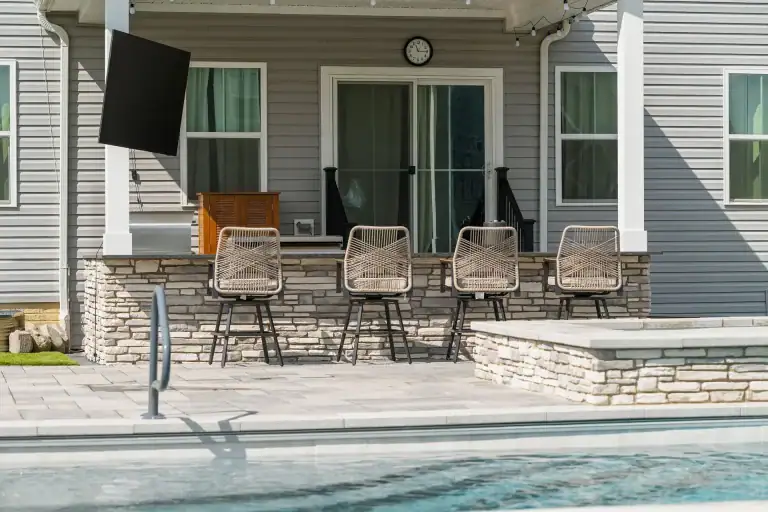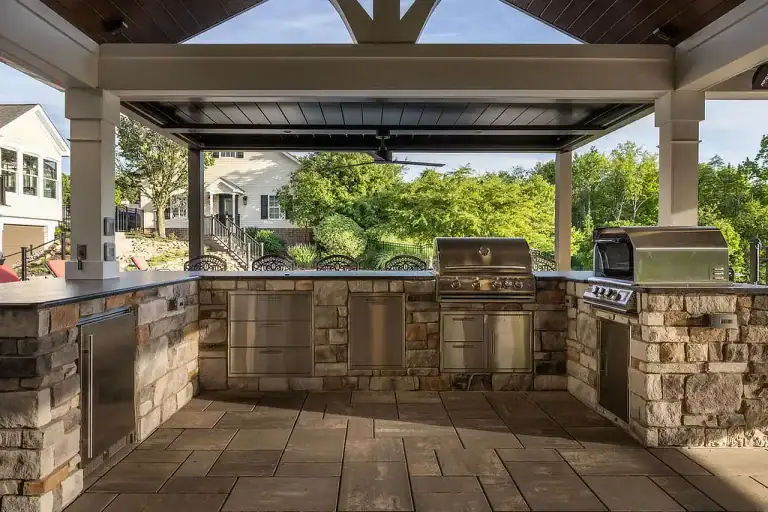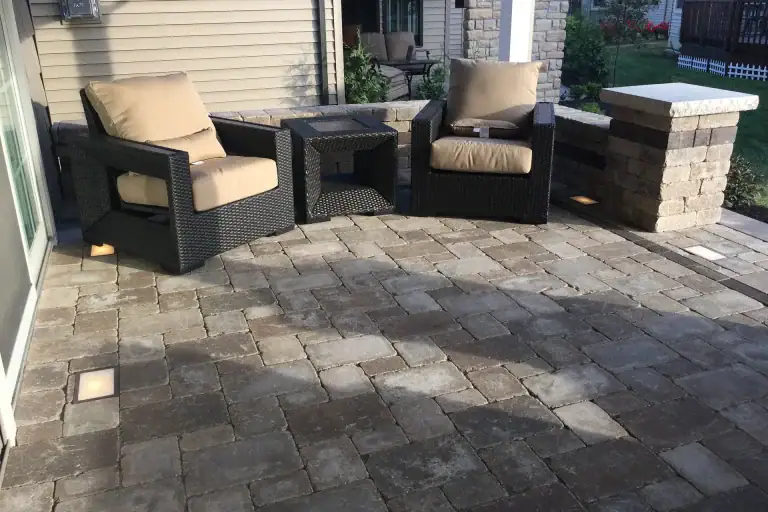
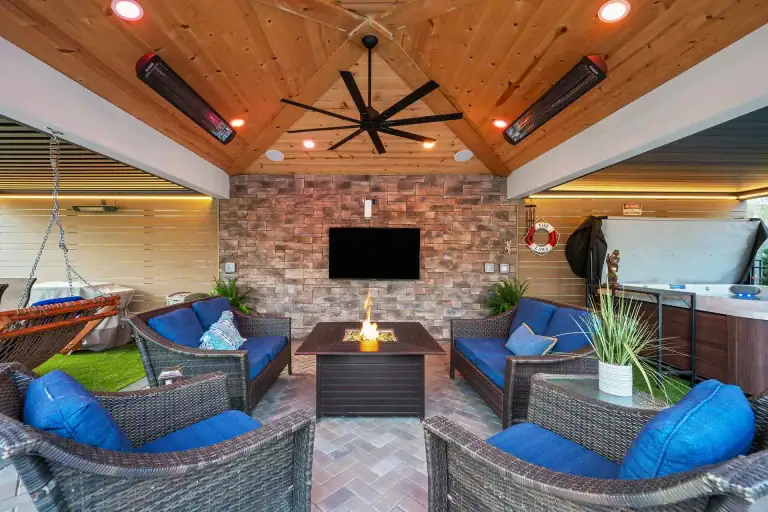
Yes. The ones built for it do, for decades, with no seasonal disassembly and nothing covered in tarps.
The ones that don’t tend to fail in a predictable order, and every point in that order was decided at the design stage rather than at the first frost.
Yes, if it was built for one
Here is the failure order, in the sequence it actually happens:
- The ground moves, and the island moves with it, because the footings stopped above the frost line.
- Water gets behind the stone, freezes, and pushes the veneer off whatever is behind it.
- Water sits in the lines over the winter, freezes, and splits a supply line or a fixture.
- The countertop absorbs water into surface pores or an unsealed edge and spalls, crazes or cracks.
- Cabinet doors and drawers corrode, swell or seize, depending on what they were made of.
Numbers 1 and 2 are the contractor’s responsibility and are settled before anything is built. Number 3 is yours, once a year. Numbers 4 and 5 are material choices made during design.
What fails first: the ground
Northeast Ohio soil freezes, thaws and freezes again all winter, and water in it expands every cycle. Anything bearing above the frost line gets lifted, then dropped, then lifted again.
Footings go below the frost line, around three feet down in most of this area, with the exact depth set by your local building department. We explain the mechanism in more detail in how to choose an outdoor living contractor in Northeast Ohio.
What that movement does to a kitchen specifically is worse than what it does to a patio, because a kitchen is rigid and tall. A patio field can lift and settle back. We watched one of ours rise close to six inches over a winter and return in the spring with no lasting damage. An island cannot do that. When one corner lifts and another doesn’t, the island racks. The countertop seams open, the appliance openings go out of square, the doors stop closing, and the stone veneer cracks along the mortar lines. None of that goes back when the ground thaws.
What fails next: water behind the stone
Two outdoor kitchens can look identical on the day they are finished and be built entirely differently underneath.
One has a masonry core: block, laid and reinforced, with the stone veneer set to it. The other has a frame of studs and cement board with stone applied to the face. The second is faster, cheaper and finishes beautifully.
Here is the difference two winters later. Water reaches the back of any veneer eventually, through joints, through the counter perimeter, through capillary action at the base. Against block it has almost nothing to do. Against a framed cavity it collects, freezes, and expands with enough force to push the veneer off the board, and the fasteners and the board itself begin to go. The first sign is usually one stone that sounds hollow. The second is a vertical crack.
We build to the masonry version, which is part of why the price works out where it does. We broke that down in what an outdoor kitchen actually costs in Northeast Ohio.
Countertops, cladding and cabinets that take a freeze
The property that matters for all of it is water absorption. A material that takes water in will eventually have that water freeze inside it, and freezing water is stronger than almost any surface finish.
Countertops. Dense, low-absorption materials handle Ohio winters best. Granite performs well sealed and re-sealed on a schedule. Porcelain is dense and holds up without much maintenance. Concrete can work but wants sealing and will show its age. Marble and other soft, porous stone are the wrong choice outdoors here regardless of how good they look indoors. Whatever you pick, the edges and the underside of the overhang matter as much as the top, because that is where an unsealed face takes water in.
Cladding. Natural stone and dense manufactured units set in mortar over block, not applied over board. The thinner and lighter the cladding, the more the substrate behind it decides its fate.
Cabinetry and doors. Marine-grade stainless and powder-coated aluminum are the categories that survive outdoors without attention. Untreated wood and uncoated steel do not, and a hinge that seizes in February is usually a hinge that was never rated for outdoors.
The water lines are the part you have to manage
If your kitchen has a sink or an ice-maker line, it has water in it, and water left in a line over an Ohio winter is the most common avoidable failure on the whole project.
The work is simple when the design accounts for it. Shut off the supply at a valve you can actually reach, open the outdoor fixture, drain the line down, and leave the fixture open for the winter. Traps get cleared. That is it, and it should take one visit in November.
The design decision is making it possible: a dedicated shut-off in a location you can get to, a line that drains rather than holding water in a low spot, and a fixture that can be left open. Ask about all three before the plumbing is routed, because retrofitting a shut-off into a finished island is unpleasant work.
Covered or open: what a roof changes in January
A roof over a kitchen changes the maintenance picture more than the temperature does. It keeps snow off the counter, keeps meltwater from running over the appliances and down the face of the stone, and keeps the cooking area usable when something is falling out of the sky.
It is also a structure that has to carry snow load, which means its own engineering and its own footings. A pergola with a louvered roof gives you adjustable cover and sheds rain when closed. A pavilion gives you a solid roof and full shelter. We explain the difference in pergola, pavilion, veranda or gazebo.
Uncovered kitchens survive Ohio winters perfectly well when they are built right. Covered ones get used more months of the year.
Using it in winter
This is the part most people don’t expect. A well-placed kitchen with a heat source attached to it is usable well past the point where the furniture gets put away.
A fire pit or fireplace near the seating, a covered cooking area, and some light makes November and March ordinary rather than exceptional. Grilling in the snow is a normal thing to do in Ohio when the path is clear and the grill is twelve steps from the door. The limiting factor is almost never the equipment.
Build it for the winter from the start
Nearly everything in this post is decided before anything is built, and almost none of it can be added afterward. Footings, substrate, material choice and a reachable shut-off are design decisions, not upgrades.
Our outdoor kitchens page covers how we build them, and if you are choosing between firms, outdoor kitchen designer or builder covers that question specifically. When you want to talk about your own yard, request a quote.
TAB Property Enhancement has built outdoor kitchens across Northeast Ohio for 18+ years. Unilock Authorized Contractor and winner of the 2024 Unilock Best Outdoor Living Award, TimberTech Platinum Elite Contractor, Best of Houzz eight times from 2019 through 2026, A+ with the BBB, more than 100 five-star reviews. Licensed, bonded and insured.