Two contractors walk the same backyard. One bid comes back a third higher than the other, and both arrive as a single page with a total at the bottom. Nothing in either document tells you where the difference went.
These seven questions will. They are the ones we would ask if we were hiring this work instead of doing it, and each one has an answer you can check before you sign anything. We have answered all seven for TAB Property Enhancement below, on the record.
Are they certified by the manufacturer, or do they just buy the material?
“We install AZEK” is a purchasing decision. Anyone with a supplier account can say it. Certification is a different thing: the manufacturer trains the crew, reviews completed installations, and attaches its own name to the outcome. It can also be taken away, which is what gives it weight.
TAB is a TimberTech Platinum Elite Contractor, and we build decking in AZEK and TimberTech composite only. On hardscape we are a Unilock Authorized Contractor and we won the 2024 Unilock Best Outdoor Living Award. We also build with Techo-Bloc pavers, and we will tell you straight that Techo-Bloc is a material we buy, not a credential we hold.
Use that distinction when you read anyone’s website, including ours. A manufacturer logo on a homepage is not a certification. Ask which relationships are earned and which are just accounts, get the exact program name, then look it up on the manufacturer’s own site. It takes two minutes and it eliminates bidders.
Our decks and porches and paver patio pages name every material we build with.
How deep do they set footings, and what do they say about freeze-thaw?
Ask this one early. It sorts the field faster than anything else on the list.
Northeast Ohio soil freezes, thaws, and freezes again through the winter. Water trapped in it expands every time, and the movement lifts whatever sits on top. That is how a pergola post rises out of plumb, how a patio field cracks along a seam, and how a roofed structure slowly separates from the house it was attached to. None of it shows up in year one, which is the problem.
Footings have to bear below the frost line. In most of this area that means going down around three feet, and the exact minimum is set by your local building department, not by whatever depth fits the crew’s schedule that week. Paver work has a parallel answer: excavated subgrade, aggregate base compacted in lifts rather than dumped in at once, edge restraint, joints sanded properly. A patio set on four inches of loose fill looks identical to a correct one for about a season.
So ask how deep, then ask why that depth. A contractor who says “to code” without knowing what the code requires has just told you how closely they follow it. This is the part of the job you will never see again once the grass grows back, which is exactly why it gets skipped.
Will subcontractors do the work?
There is a version of this business where the person who sells you the project never appears again and a rotating crew you have not met does the building. You find out on day one.
You are entitled to a direct answer before then. Ask who performs the structural and masonry work, whether that crew belongs to the contractor, and who supervises the site day to day. Licensed trades are a reasonable exception. Gas connections and electrical runs are performed by licensed specialists on any project of this kind, because the law requires it and because you want it that way.
What should concern you is a company that subcontracts the build and still markets itself as the builder. Ask for the name of the supervisor who will be on your project. If nobody can give you one, that is the answer.
Can they show you the design before you commit?
You should see the finished project before you spend money on it. Not a sketch on the back of a proposal. A design.
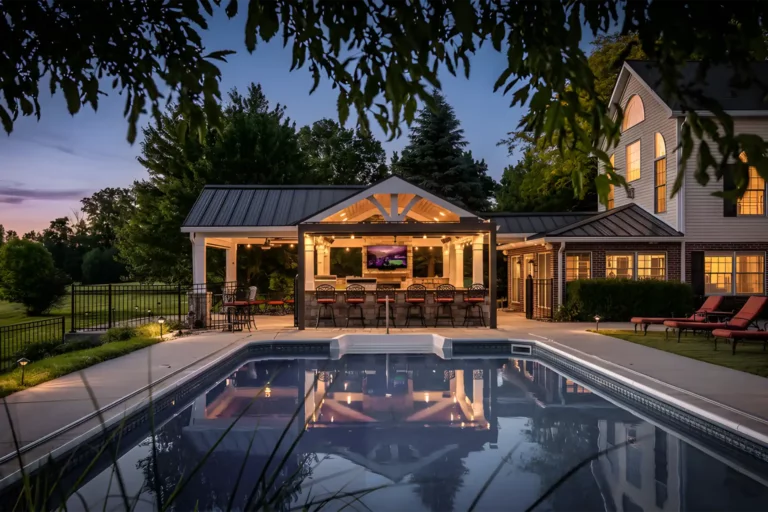
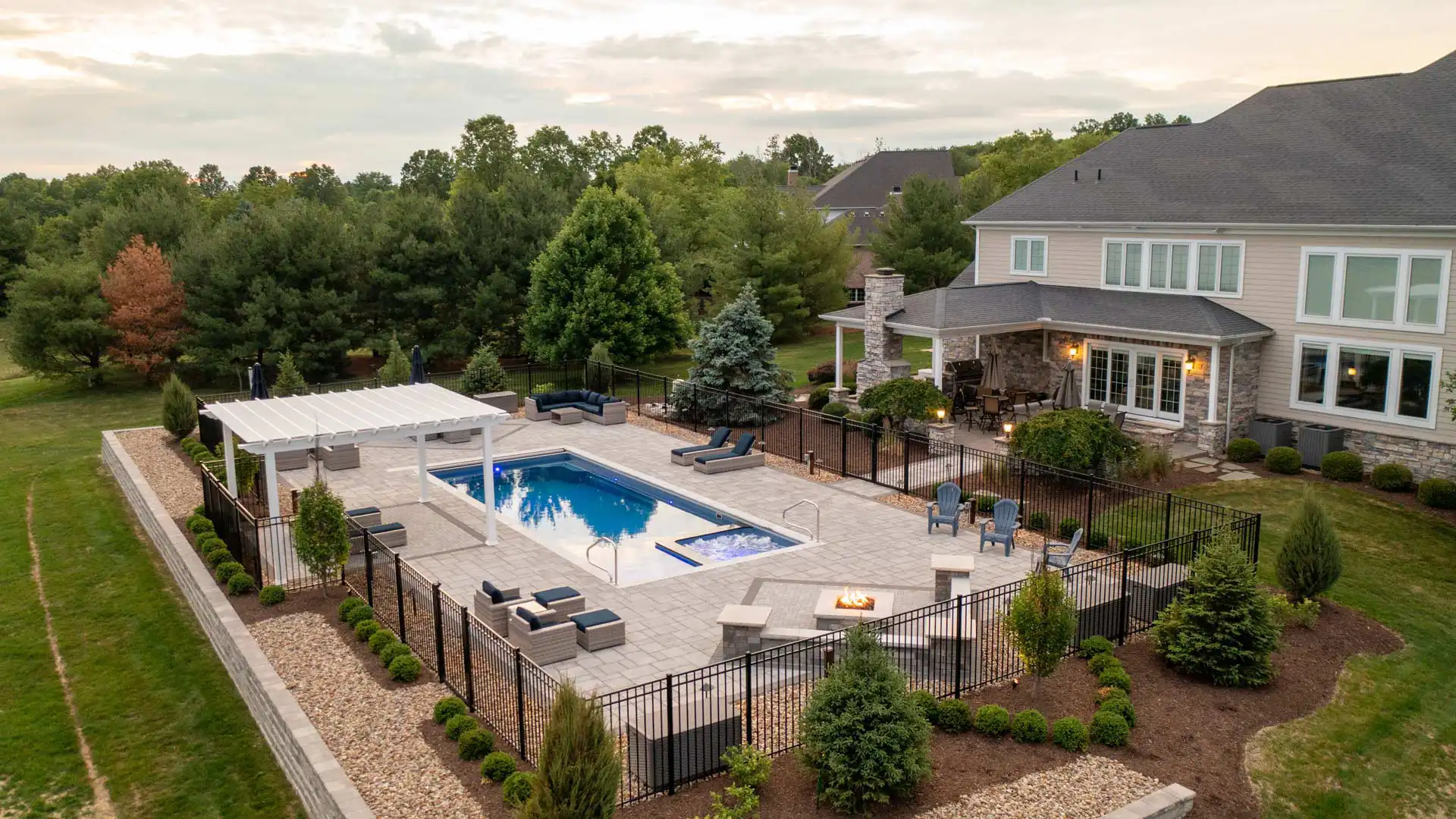
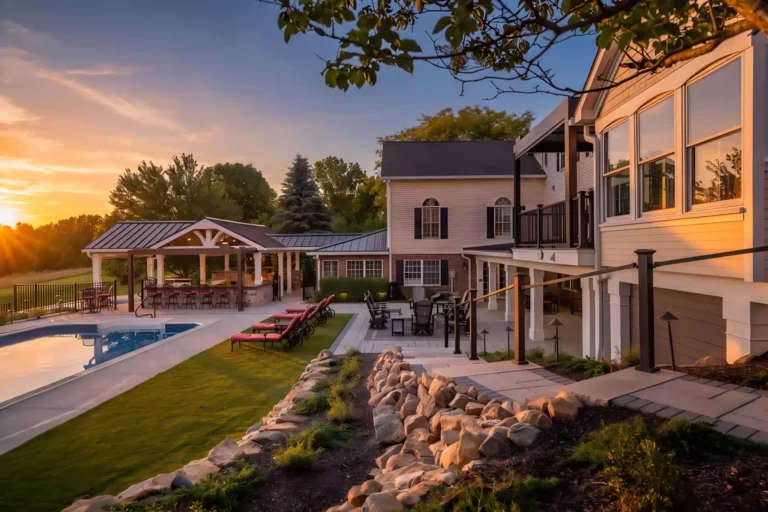
Our process runs in four stages and it is the same on every project: design consultation, then 3D design and rendering, then build, then a final walk-through. The rendering stage is where expensive changes are cheap. Moving a grill island four feet, widening a landing, putting a pergola over a seating area instead of beside it, all of that costs nothing while it is still a model and a great deal once it is footings and stone.
It also protects you on price. When you can see the structure from every angle, you can tell whether two bids describe the same project. Most of the time they do not. Our completed projects show what the finished version of that process looks like.
What does it actually cost, and will they say so before a consultation?
Most contractors in this market publish no numbers at all. That is convenient for them and useless to you, so here is what we can put in writing.
Paver patios run $16 to $28 per square foot installed, depending on the paver line, the pattern, and how much excavation and base work the grade demands. We published that figure and the reasoning behind it in 7 benefits of paver patios vs. concrete, and it has not moved.
Outdoor kitchens are harder to reduce to a single number honestly, because five things move it more than anything else:
- Footings and base prep. How far down we have to go, and what the grade and access allow.
- The appliance package. Usually the largest single variable, and the one homeowners change most between the first conversation and the final design.
- Countertop material. A granite or porcelain top and a stock slab are not close to each other in price.
- Gas and electrical runs. The most commonly underestimated line on any outdoor kitchen bid. The distance from the house decides it.
- A roof or shade structure over the top. A covered kitchen is a second structure with its own footings.
What you should expect from any contractor, including us, is a realistic range over the phone based on those five inputs before anybody drives out. A company that will not give you one until it has you in the backyard is managing you, not pricing your project. Ask for the range, and ask what would push the number to the top of it.
Who pulls the permits, and do they work year-round in Ohio?
Permits are the contractor’s job. Decks over a certain height, roofed structures, gas lines and electrical all get permitted and inspected here, and every municipality in our service area runs its own process. If a bid is quiet about permits, ask whether that is because they are included or because nobody intends to pull them. An unpermitted structure becomes your problem when you sell the house.
The season question matters too. Design and permitting take weeks, and the useful thing to know is that they do not require good weather. We design, engineer and permit through the winter so that the build starts as early in the spring as the ground allows. Masonry and concrete work do have temperature limits, and any contractor who tells you otherwise in February is selling you a delay.
Ask where you would sit in the schedule if you signed this month, and what happens to that date if the permit takes four weeks instead of two.
What does the warranty cover, and how long have they stood behind it?
There are two warranties on a project like this and they are not the same. The manufacturer covers the material. The contractor covers the installation. A composite decking warranty means very little if the frame under it was built wrong, and most material warranties are only valid when a certified installer does the work, which is where the first question on this list pays off.
Ours runs in those two layers, and we will say exactly what sits in each. Our workmanship warranty covers the masonry, the counters and the installation itself. The manufacturer warranties cover the components, and we register them on your behalf rather than leaving you a stack of cards to mail: the stainless appliances, the Unilock, Techo-Bloc or stone in a surround, and any refrigeration. Appliance warranties vary by brand, and we will match the appliances to the warranty level you want. You get the full paperwork at the final walk-through.
Ask any contractor for the workmanship term in writing, and for what it excludes in writing too. Then ask the only question that tests it: how long has this company been in business under this name? A warranty is a promise about the future from a company that has to still be here to keep it.
TAB has been building in Northeast Ohio for 18+ years. We are licensed, bonded and insured, we hold an A+ rating with the BBB, we have won Best of Houzz eight times from 2019 through 2026, and we have more than 100 five-star reviews from homeowners in this area. Our about page carries the full record.
Take these to every bid
If you are collecting bids right now, take these seven questions to every contractor on your list before you take them to us. A good one will have answers ready and will not mind being asked.
When you want to talk about your own yard, a design consultation is where it starts. No pressure and no obligation, just a conversation about what you are trying to build. Request a quote and we will set it up.