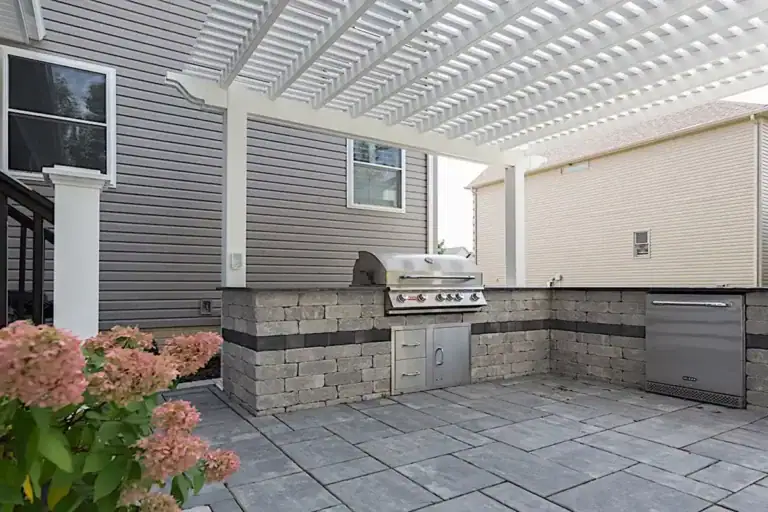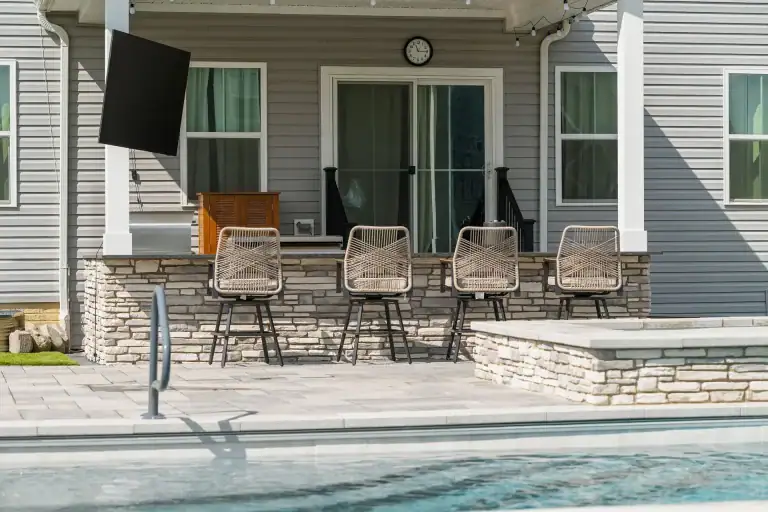
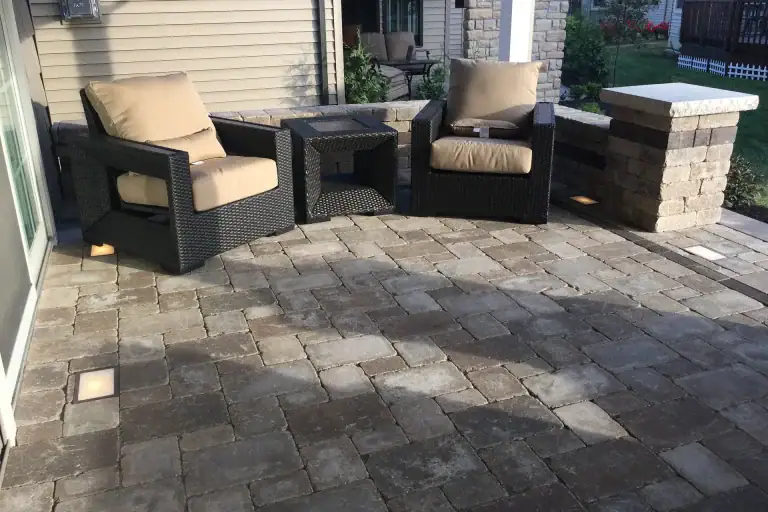
Paver patio prices in this market vary more than the materials do. Two bids for the same square footage, the same brand and the same pattern can sit thousands of dollars apart, and almost all of that difference is below the surface where you cannot inspect it.
Here is what the number is made of, what changes it, and what to ask about the part you will never see again.
The short answer
A Unilock or Techo-Bloc patio runs $35 to $40 per square foot installed, and an honest per-square-foot price covers everything: excavation, base, bedding, the paver, edge restraint, joint sand and haul-away. If a quote leaves any of those out, it is not comparable to one that includes them.
Where a project lands depends on three things more than anything else: the paver line you choose, how much the pattern has to be cut, and what the site makes us do before we can start building. A flat, open, grass-over-topsoil backyard is the cheap version. A sloped lot with a slab to tear out and a gate too narrow for a machine is not.
A bid that comes in well under the others usually has a thinner base. One that comes in well over them usually includes work that is not patio: steps, walls, a fire feature, a kitchen.
Size works differently than people expect. Per square foot, a larger patio often costs slightly less than a small one, because mobilization, excavation setup and haul-away get spread across more area. The saving is modest and it does not survive a complicated shape. A compact rectangle is efficient. A 700-square-foot patio with three curved edges and two elevation changes is not, whatever the square footage says.
What’s in the number
Everything that matters about a paver patio happens before the first unit goes down.
Excavation removes topsoil and organic material to a depth set by the base thickness the project calls for. Organic material holds water, water freezes, and anything built over it moves.
Aggregate base, compacted in lifts. This is the structure of the patio. Crushed aggregate goes down in layers, each one compacted before the next, because a deep pile compacted once from the top is loose underneath. The depth depends on soil, drainage and whether the surface will ever carry anything heavier than furniture.
Bedding, pavers, edge restraint and joint sand. A thin, screeded setting layer, then the units, then a restraint around the perimeter that keeps the field from spreading, then sand swept into the joints so the units lock against each other and act as one surface.
Haul-away. Spoil from the excavation has to go somewhere, and on a tight site that is a real line on the bid.
When bids diverge, ask each one for its excavation depth and base depth in inches, and how the base is compacted. A bid that will not answer in numbers is the bid with the thinnest base.
Unilock or Techo-Bloc: what changes the price
We install both. Both are made for this climate and both will outlast concrete here.
What moves cost between them is not the brand name, it is where in each brand’s catalog you land. Entry lines are simpler units in standard sizes and finishes. Mid lines add surface texture, color blending and more size options. Premium and large-format lines cost more per square foot to buy and more to install, because the units are heavier, the tolerances are tighter and the layout has less forgiveness.
Pattern complexity is the other lever. A running bond in a rectangular space cuts very little. A herringbone field with a soldier-course border and a curved edge means a great deal of cutting, and cutting is labor.
We are a Unilock Authorized Contractor and we won the 2024 Unilock Best Outdoor Living Award. We also install Techo-Bloc, which is a material we buy rather than a credential we hold. Both are good products. Only one of them carries an authorization we have earned.
What a Unilock Authorized Contractor means for you
Authorization is earned and inspected, not bought. By Unilock’s own description, a contractor has to show five or more years installing hardscapes, pass homeowner reference checks and prove liability and workers’ compensation coverage. Unilock then inspects projects in progress to check excavation, grading, compaction and base materials, inspects recently finished work, and inspects projects completed more than three years earlier to confirm the construction has held up.
For you that matters in two practical ways. Unilock guarantees an Authorized Contractor’s installation work for two years, and says it will step in and back that guarantee if the contractor cannot. And the inspection that matters most here is the one on three-year-old work, because that is where a thin base shows itself.
Ask any contractor which manufacturer relationships are earned and which are supplier accounts. Then check the claim on the manufacturer’s own site. It takes two minutes.
What moves the number beyond the surface
- Grade and access. A sloped site needs the grade managed before anything is built. A yard a machine cannot reach means hand-hauling every ton of aggregate.
- Tear-out. An existing concrete slab has to come out and go away. That is demolition, disposal and time.
- Steps. Any change in elevation between the house and the patio is its own structure.
- Seat walls and retaining walls. Walls are built, not laid, and they carry their own base and drainage requirements.
- A fire feature. Masonry, a gas line if it is not wood-burning, and a footing.
- An outdoor kitchen on the patio. A separate project sharing the same surface. We covered the tiers in what an outdoor kitchen actually costs in Northeast Ohio.
- Drainage. Where the water goes when the surface is no longer lawn. On some sites this is nothing. On others it is a meaningful line.
Driveways and walkways price differently again, because a driveway carries vehicle loads and needs a base built for them.
Pavers or concrete over twenty winters
This is the part of the comparison that does not show up in a first-year price.
A poured slab is one rigid piece. Ohio soil freezes, thaws and freezes again all winter, the ground moves every cycle, and a rigid slab either resists the movement or cracks. Once it cracks, the repair is replacement.
A paver field is thousands of individual units over a flexible base. It moves with the ground instead of fighting it. We watched a patio we built lift close to six inches over a Northeast Ohio winter and settle back in the spring with no lasting damage, which is a thing a slab simply cannot do. And when a section does need attention years later, the units come up and go back down. There is no seam and no color-matched patch.
We wrote the longer comparison in 7 benefits of paver patios vs. concrete.
Getting a number for your yard
You should get a realistic per-square-foot range over the phone, from any contractor, once they know roughly the size, the site and which brand line you are drawn to. That should come before a site visit, not after.
After that the process is the same on every project: design consultation, then 3D design and rendering, then build, then a final walk-through. You approve the layout, the paver line and the pattern as a model before anyone digs.
Our paver patios page has the material detail. When you want a number for your own yard, request a quote.
TAB Property Enhancement has built in Northeast Ohio for 18+ years. Unilock Authorized Contractor, winner of the 2024 Unilock Best Outdoor Living Award, Best of Houzz eight times from 2019 through 2026, A+ with the BBB, more than 100 five-star reviews, licensed, bonded and insured.