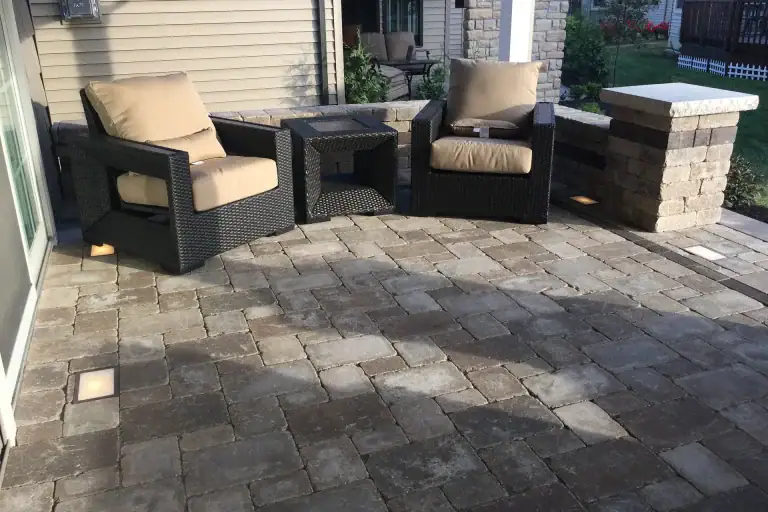
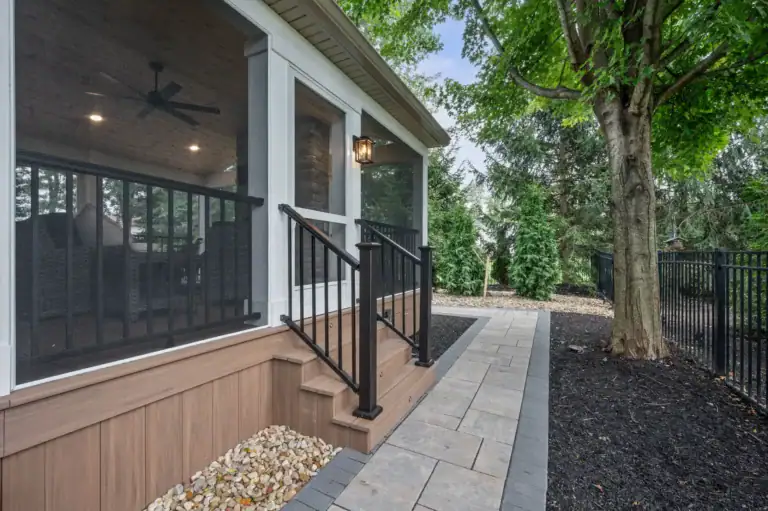
National cost guides put a paver driveway at $10 to $30 per square foot. Our paver patios run $35 to $40.
Both numbers are real. They describe different work, and the difference is almost entirely below the surface, which is where a driveway either survives an Ohio winter or starts coming apart in year three.
The short answer
Here is what we can state plainly. A Unilock or Techo-Bloc patio runs $35 to $40 per square foot installed. That figure covers excavation, base, bedding, the paver, edge restraint, joint sand and haul-away, and we publish it because we stand behind it. The full breakdown is in what a paver patio costs in Northeast Ohio.
A driveway is built to a heavier spec than a patio, so we price it per job rather than publishing a square-foot range we would have to walk back on half the projects we quote. Walkways we quote the same way, because a front walk with three steps and a landing is a different job than forty feet of straight path.
What we will do here is tell you exactly what the money is buying, so you can read any driveway bid and see where it went.
One thing to watch while you compare: the Cleveland-specific figure you will find online comes from a cost-directory page dated 2022, and it assumes a four-inch base. Keep that in mind through the next section.
Same system, different load
A walkway, a patio and a driveway are the same system. The only variable that matters is the load the surface has to carry.
A walkway carries people. A patio carries people, furniture and a grill. A driveway carries a two-ton vehicle that stops in the same place every day, turns its wheels while stationary, and does it through a whole winter of freeze and thaw. Power steering against a paver surface is a shearing force, not a weight, and it is the single thing a patio base is not built for.
Four things change as the load goes up:
- Base depth. More aggregate, and it matters more than any other line on the bid.
- Compaction. The base goes in and gets compacted in lifts rather than dumped and rolled once from the top. A deep layer compacted only at the surface is loose underneath, and loose underneath is where ruts start.
- Paver thickness. Driveway work uses thicker units rated for vehicle traffic. A patio paver in a driveway will crack, and no base fixes that.
- Edge restraint. The perimeter is what stops a field from spreading. Under vehicle load it is doing real work, especially at the apron and along any edge a tire crosses.
We say the same thing on our Avon and Hudson pages: patios, walkways and driveways all run through the same base spec, and the only thing that changes is the load the surface has to carry. That is not marketing language. It is the whole reason the prices differ.
Why the cheap numbers don’t survive an Ohio winter
A four-inch base is a walkway base.
Put a vehicle on it here and three forces go to work. Freeze-thaw lifts and drops whatever is above the frost line, repeatedly, all winter. Plows scrape and catch edges. Salt and meltwater drive down into the joints and the base, and when the water in a poorly draining base freezes, it expands against everything around it.
The result is familiar to anyone who has looked at a cheap paver drive after a few years: ruts in the wheel tracks, a dip where the car parks, units spreading at the edges, and a crown that no longer sheds water where it used to. None of that is a paver failure. It is a base failure showing up through the pavers.
We set Unilock and Techo-Bloc over a base built for freeze and thaw, with drainage designed for Ohio ground rather than a national average. That is also why our number does not match a national blend, which is dominated by entry-level work in climates that never see a hard frost.
How long they last, and what “last” means for pavers
National cost guides put paver driveway lifespan at 25 to 50 years. That range is wide because it depends almost entirely on the base, which is the part nobody is inspecting when they compare bids.
But lifespan means something different for a paver surface than for poured concrete, and this is the part worth understanding before you choose.
A concrete drive is one rigid piece. It either resists ground movement or it cracks, and once it cracks the repair is replacement or a patch that never matches. A paver drive is thousands of individual units over a flexible base. It moves with the ground instead of fighting it, and when a section does need attention, the units come up and go back down. No seam, no color-matched patch, no tear-out.
We have seen a paver patio lift close to six inches over a Northeast Ohio winter and settle back in the spring with no lasting damage. A slab cannot do that.
So “lasts 30 years” for pavers does not mean untouched for 30 years. It means serviceable for 30 years, which is a better promise.
Unilock or Techo-Bloc for a driveway
We install both, and both make units built for vehicle traffic.
What changes cost between them is where in each catalog you land rather than which name is on the pallet. Entry lines are simpler units in standard sizes and finishes. Mid and premium lines add surface texture, color blending, more size options and larger formats, and the large formats cost more to buy and more to set.
Pattern matters too. A running bond cuts very little. A herringbone field with a border cuts a great deal, and cutting is labor. Herringbone is also the pattern that interlocks best under vehicle load, so on a driveway it is frequently the right answer rather than the expensive one.
We are a Unilock Authorized Contractor and a three-time Unilock Best Outdoor Living Award winner (2022, 2023, 2024). We are also a Techo-Pro Contractor, Techo-Bloc’s contractor program. When any contractor shows you a wall of manufacturer logos, ask which programs they actually belong to.
Tear-out, grade, and other things that move the price
- Removing what’s there. An existing asphalt or concrete drive has to come out and go away. Demolition, disposal and time, and on a long drive it is a significant line.
- Grade and drainage. Where the water goes once the surface changes. On a flat lot this is nothing. On a sloped drive running toward a garage, it is the most important thing on the plan.
- The apron at the street. The transition to the public road sometimes needs a right-of-way permit from the municipality, which is our job to handle and worth asking any bidder about.
- Access and turning. Width at the turn, the radius a vehicle actually needs, and whether our equipment can reach the work.
- Lighting. Along a walkway especially, low-voltage lighting is easiest and cheapest to run while the base is open.
Getting a number for your driveway
A conversation and a look at the site, then a real number. Not a square-foot figure applied to a measurement, because the base is where the cost lives and the site decides the base.
Our process runs the same way on every project: design consultation, then 3D design and rendering, then build, then a final walk-through. You see the layout, the paver and the pattern before anyone breaks ground. The paver patios page has the material detail, and our projects show finished work.
TAB Property Enhancement has been building in Northeast Ohio for 18+ years. Unilock Authorized Contractor, Techo-Pro Contractor, three-time winner of the Unilock Best Outdoor Living Award (2022, 2023, 2024), Best of Houzz eight times from 2019 through 2026, A+ with the BBB, more than 100 five-star reviews, licensed, bonded and insured.
When you want a number for your own driveway, request a quote.