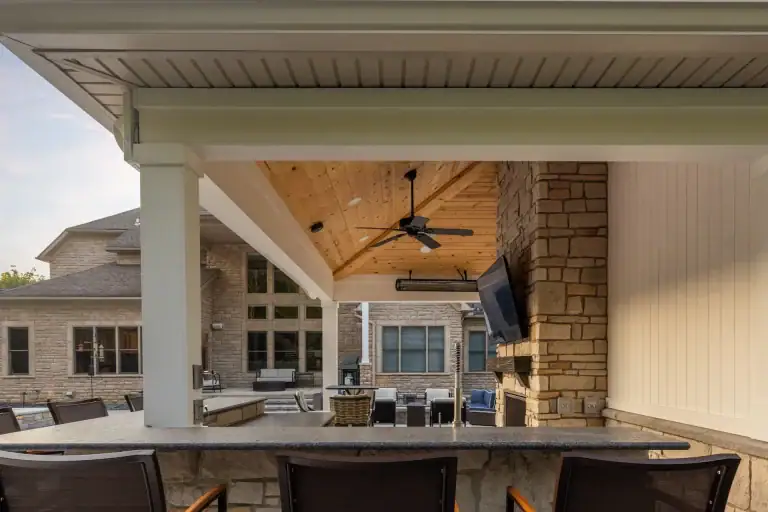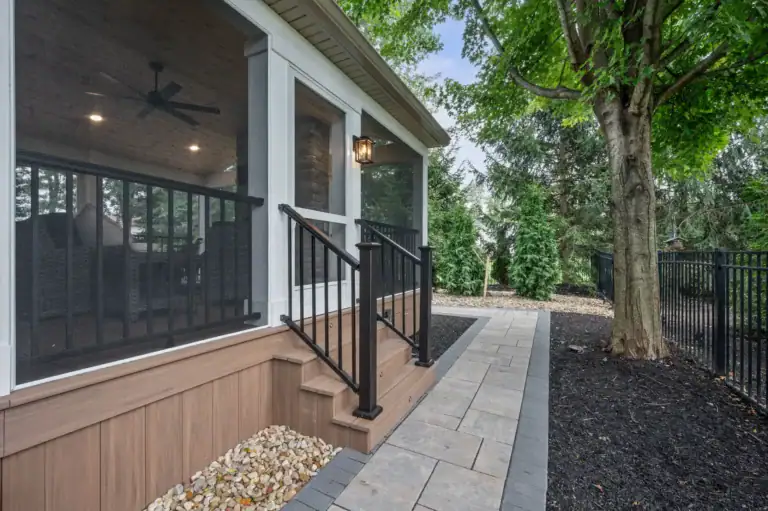
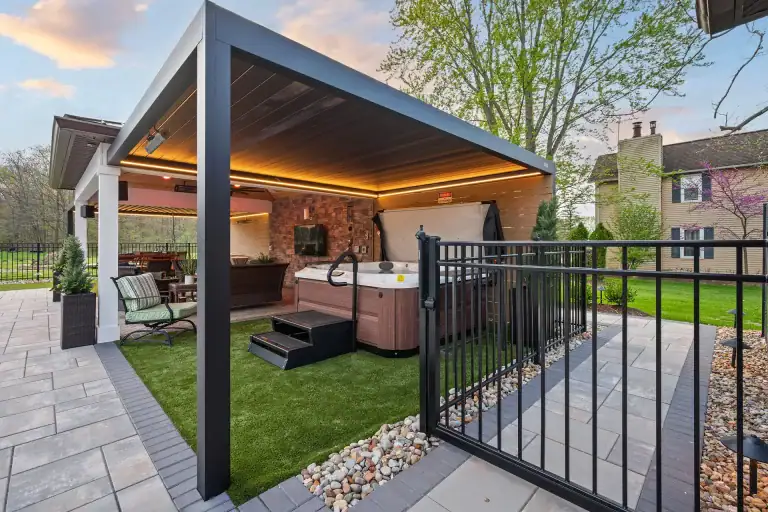
If you’re weighing a louvered roof against a fixed one, there are really two questions. The first is what kind of shade you want, and that one has a quick answer. The second is how the roof will handle a Northeast Ohio winter, and that’s where most of this post goes.
The short answer
A fixed roof gives you one condition all the time: shade where the slats are, sun where they aren’t, and rain comes through either way.
A louvered roof rotates. Open it for sun, angle it for partial shade, and close it when the weather turns so it sheds rain into the frame’s own drainage. If you plan to sit out there in changing weather, a louvered roof is usually the better fit.
We build both: louvered roofs, and fixed-roof pergolas in powder-coated aluminum and western red cedar. If you’re curious what a custom pergola costs either way, we covered that in pergola installation in Ohio.
What a louvered roof actually does
The blades pivot on a shaft that runs the length of the roof. Open, they stand nearly upright and let most of the light through. Closed, they overlap into one continuous surface, and water runs along each blade into channels in the beams and down through the posts. That drainage path is why a closed louvered roof keeps the table dry instead of dripping along every seam.
You can operate one by hand with a crank or handle, or go motorized with a remote or wall control. Some powered systems also offer a rain sensor that closes the roof on its own.
It helps to know going in that a louvered roof isn’t a solid roof. The blades are an assembly with seals and moving parts, so the more useful question isn’t “is it watertight” but “how does it drain, and how does it handle weight?” That’s mostly a winter question.
PERGOLUX and Hideaway TitanCover: what we install, and how they differ
We install two louvered systems, PERGOLUX and Hideaway TitanCover.
PERGOLUX shares the most technical detail of the two. On its own site it lists wind resistance up to 165 mph and a 10-year warranty on the aluminum structure. Its Pro models offer motorized louvers with remote and app control, and the base model is manual. PERGOLUX also sells direct to homeowners as a kit (more on that below).
Hideaway TitanCover keeps its product page simpler. It describes a sealed, watertight louver system with a wide tilt range, and it doesn’t list snow or wind figures there.
Those figures are the manufacturers’ own. In practice, which system we recommend comes down to the look you’re after, the span, and how you’d like to operate the roof.
What a louvered roof does in an Ohio winter
Brochures tend to skip this part, so here’s what we tell homeowners.
Snow will sit on closed louvers. A closed roof is a surface, and surfaces collect snow. What to do about it depends on the system: some are designed to be opened to let snow drop through, and others shouldn’t be operated while they’re loaded. It’s worth knowing which kind you have before the first storm, and following that manufacturer’s guidance.
Deep cold limits operation. Motorized louvers are rated for a range of operating temperatures, and a hard Northeast Ohio cold snap can push past the low end. The practical takeaway is a small one: set the roof where you want it before a deep cold stretch rather than cycling the louvers during one. Closed is a sensible default.
The headline snow number isn’t your number. PERGOLUX publishes snow-load figures that vary by model and configuration, and TitanCover doesn’t list one on its product page. That’s not a knock on either brand. A load rating depends on the structure under the roof, and a manufacturer that doesn’t install the product can’t know what yours will be.
Why the brochure number isn’t your number
What a roof can carry on your house comes down to four things, and all four depend on how it’s built.
Span. The distance between posts sets the beam, and the beam sets what the roof above it can hold. A roof rated for one load across ten feet isn’t rated for the same load across sixteen.
Post layout. Four posts and six posts are different structures, even under the same roof.
Attachment. A freestanding pergola and one tied into the house carry load differently, and the connection to the house has to be designed and flashed properly.
Footings. Set below the frost line, so the posts stay put through freeze and thaw. It’s why our pergolas page talks about footings and connections sized for Ohio wind and snow load.
So when you talk with a contractor, it’s fair to ask what your configuration is rated to carry, not just what the brand’s best model can handle. The second answer is on a web page. The first takes someone looking at your yard.
The kit and the installed version
PERGOLUX sells the same product line directly to homeowners as a kit, and it’s a good product. If you need a freestanding structure on an existing slab and you’re comfortable putting it together, buying it that way can make sense.
What a contractor adds is the part a kit can’t include: footings poured below the frost line, a post layout and span designed for the load, a structural attachment to the house if it’s attached, electrical for lighting, heat or fans, and a configuration someone can tell you the rating of. The product in the box is the same. What it stands on is where the difference is.
The cost difference follows from that list, and we broke it down in pergola installation in Ohio.
When a fixed roof is the better choice
A louvered roof isn’t always the right call.
A fixed roof makes sense when you love the character of a cedar structure, when the budget is better spent on the size of the space than on the mechanics of its roof, or when the pergola is mostly decorative, over a walkway or an entry rather than a spot where you’ll sit for hours.
And if what you really want is full shelter rather than adjustable shade, the answer may not be a pergola at all. A solid-roof structure is a different build with different costs, which we laid out in pergola, pavilion, veranda or gazebo.
Talk to us about your roof
TAB Property Enhancement builds pergolas across Northeast Ohio, fixed and louvered, with footings and connections sized for Ohio wind and snow load. Our pergolas page has the material and system details, and you can see a louvered pergola over a custom paver patio in our project work.
18+ years in business, Best of Houzz eight times from 2019 through 2026, A+ with the BBB, more than 100 five-star reviews, licensed, bonded and insured.
When you’d like a configuration and a rating for your own yard, we’d be glad to take a look. Request a quote.